Trees and shrubs
Discover the flora and fauna of Westerbergen holiday park in Drenthe
The exact number of different plant species at Westerbergen is unknown. Indeed, it is not easy to determine, as it is all too easy to overlook a small plant. The situation is different with trees and shrubs; one does not simply walk past them. To be precise, there are around forty different species on Westerbergen, which is still a respectable number. However, as with the wild plants, only a
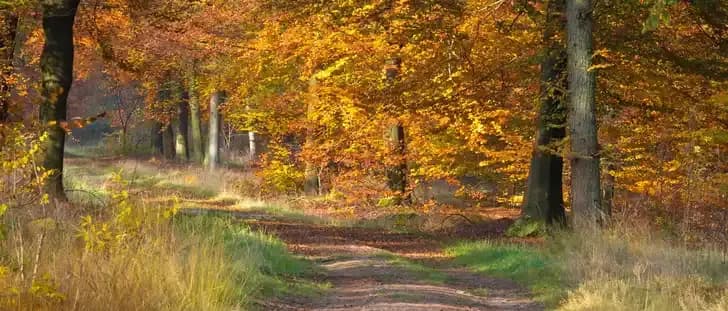
limited number will be discussed below, and in principle only those that occur in significant numbers. It should also be noted that trees and shrubs can be divided into two main groups: conifers and deciduous trees. With a few exceptions, conifers remain green all year round, whilst deciduous trees lose their leaves in autumn. Both groups occur in almost equal numbers at Westerbergen. The conifers are mainly found in the actual woodland area, whilst the deciduous trees are particularly prevalent between the bungalows numbered 34 and above and on the campsite.
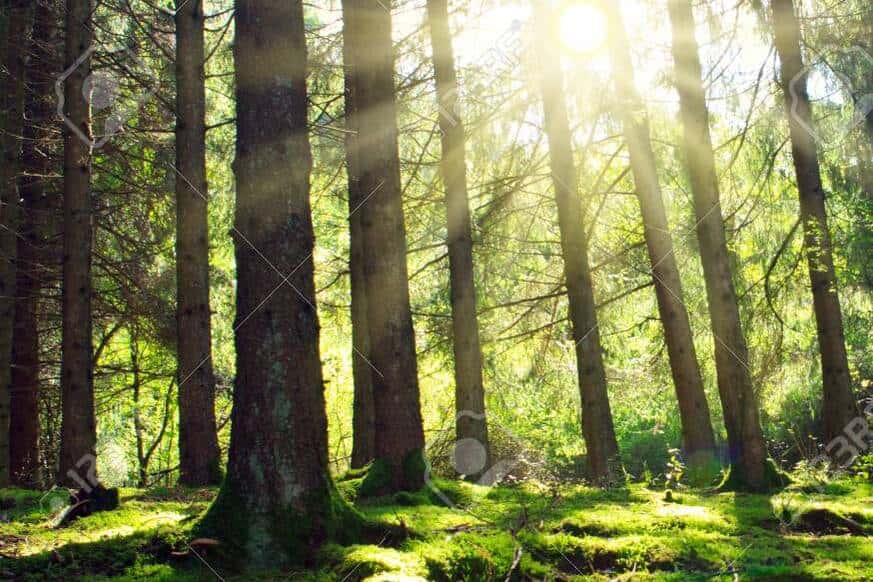

Conifers primarily include pines and spruces. This is where the confusion begins, as many people mistake pines for spruces and vice versa. The confusion stems mainly from the way we talk about Christmas trees. The Christmas tree is in fact a spruce, although people often refer to it as a ‘little Christmas pine’. The well-known Christmas carol ‘O pine tree, O pine tree’ is also partly to blame for this. Yet pines and spruces bear little resemblance to one another. When a pine has grown a little older, it has a bare trunk and only has branches with needles at the top. The shape of the tree is therefore a sphere on a stick. The spruce still has branches full of greenery close to the ground; it is broad there and becomes narrower the higher up it goes. The shape is that of a cone. A second easily distinguishable difference is the length of the needles. Pine needles are long, at least four centimetres, and usually grow in pairs. Spruce needles are short, no more than two centimetres. The needles grow individually on the twigs.
At Westerbergen, the pine is the most common tree. There are mainly pines behind the main building and in the area of bungalows 1 to 34. There are also groups of pines on the campsite near the first toilet block. These pines are all so-called Scots pines. This is the most common species in the Netherlands. The needles are green, but have a slightly grey-blue tinge, so that in a forest where spruce trees also grow, these pines stand out beautifully against the dark green of those trees.
When pines grow side by side in a forest, they push each other upwards as they grow. This results in beautiful, straight trunks. Pine seeds, however, can end up anywhere, for example on the open heathland. If such a seed germinates, the growing pine is exposed to the full force of the wind. It often spreads out widely and the trunk can take on very irregular shapes. These pines that simply grow wild – which are in fact just Scots pines – are often referred to as ‘wild pines’. There are quite a few of them on the adjacent heathland and in the Echtener Zand, where many fairly old specimens can also be found. With these old pines, it is worth taking a closer look at the bark. It has cracked open in the most fantastic way and everywhere you look you can see different layers of bark, creating a particularly beautiful pattern. When one thinks of trees, flowers do not immediately spring to mind. Yet trees do flower too. The pine does so in a distinctive way, producing two types of flower: male and female. The male flowers produce pollen, whilst fertilisation takes place in the female flowers, which subsequently develop into pine cones containing the seeds. The flowers are small in comparison to the large trees, yet clearly visible. The male flower is, as it were, a sulphur-yellow cluster of small nodules a few centimetres long. When in full bloom, say in May or June, a cloud of pollen is released if one blows on it. The female flowers are reddish-purple nodules at the end of a short twig. As mentioned, these develop into the pine cones, which are more or less egg-shaped. They are green at first and later turn dark brown. When the seeds are ripe, the woody scales part, allowing the seeds, which have a small wing, to be carried away by the wind. Eventually, the pine cone falls from the tree.
The Scots pine is a major culprit in forest fires – or rather, in most cases, it is humans – but the Scots pine is the most flammable tree. As the pine grows older and larger, the needles on the lower branches die off and fall away. Small dead twigs usually remain in place. These small twigs now dry out and are extremely flammable. If a fire creeps along the ground, the small twigs can quickly catch fire and, in no time at all, the fire has reached the top of the tree, after which the entire crown, with its flammable needles, becomes a sea of fire. To reduce the risk of fire, it is therefore essential that all dead twigs are removed from the pine up to a height of approximately two metres. There is then a chance that the fire will pass beneath the trees. All the larger Scots pines on Westerbergen have undergone this treatment.
Apart from the Scots pine, there are many other pine species, such as the maritime pine, which has particularly long needles of up to ten to twenty centimetres and which have a beautiful, fresh green colour. Everything about the maritime pine is larger than that of the Scots pine. The male flower, which is somewhat more egg-shaped here, is the size of a hen’s egg. Its colour is a little more beige. The female flower is dark red and sits on longer twigs that usually stand upright, making them look almost like candles. Finally, there are pine cones that can reach a length of at least twelve centimetres.
Just to the right of the entrance to the site there is a small group of maritime pines, and further on near bungalows 123 to 125. There are also a few scattered along the ring road through the bungalow area. Whether it will be possible to keep the maritime pines at Westerbergen into the distant future remains to be seen. Maritime pines actually belong on the Mediterranean coast, hence the name. It is actually too cold for this species in Drenthe. They are particularly sensitive to frost and quite a few die off during severe frosts. With the maritime pine, the situation is the exact opposite of that with the crowberry. Heather was once common in Drenthe but not in Brabant, whereas maritime pines are more common in Brabant, as it is often warmer there than in Drenthe. Once the maritime pines are a bit older, they become less sensitive to frost. For instance, in the Echtener Zand, close to the sand drift, there is a fairly large group of maritime pines that are all thriving. The maritime pines at Westerbergen are still young. They were grown from seed at Westerbergen in 1964. They are growing quickly, but are not yet old enough to flower. To see this, one must go to the Echtener Zand.
Finally, there is one more species of pine: the Weymouth pine. There aren’t many of them at Westerbergen, but they stand together in a small field on the other side of the road, next to the sports ground near bungalows 136 and 140. It is a particularly beautiful species with needles of yet another shade of green, verging on olive green. The needles are particularly fine and soft, in contrast to the Scots pine, whose needles can really prick you due to their sturdiness and sharp tips. The Weymouth pines arrived at Westerbergen as two-year-old saplings in 1964. They seem to feel quite at home there, as they are growing well and are already taller than a man.
After the pine, it is the spruce’s turn. With their conical shape and short, deep dark-green needles, they are truly stately trees, particularly as they usually grow so neatly upright. There are also various species of spruce. The most common species at Westerbergen is the common Christmas tree, officially known as the Norway spruce. Most of these are found in the section of the forest bordering the eastern boundary. The spruce’s spring growth is particularly beautiful. The new shoots with needles are then light green. Over the course of the summer, this colour gradually darkens, so that by the end of summer there is no longer any distinction between old and new growth. The inflorescence of the spruce, with male and female flowers, is virtually identical to that of the pine. Most of the spruce trees at Westerbergen are not yet old enough to flower. Spruce cones differ in shape from pine cones. Spruce cones are quite long and slender: they have a cylindrical shape.
Another species is the Caucasian spruce. This is easily distinguished from the Norway spruce by its very small needles, about half a centimetre long, which lie flat against the branches. Moreover, they have a sheen to them. As the name suggests, this species originates from the Caucasus Mountains, where it grows at high altitudes and thus in low temperatures. In a cold environment, everything grows much more slowly than in the warmth. Even when such a species is moved to warmer climes, its growth remains limited. This is clearly evident in the specimens at Westerbergen. They stand on either side of the lawn in front of the main building, at the entrance and at the exit of the grounds. At the entrance, there are maritime pines on the right and Caucasian spruces on the left. Just like the maritime pines, the Caucasian spruces at Westerbergen were grown from seed in 1964. To add to the confusion between the pine and the fir, there is another tree species: the Douglas fir. It is referred to as both Douglas pine and Douglas fir, yet it does not really belong to either group. There are a number of different specimens in the woodland behind the main building. At first glance, they resemble the Norway spruce. The dark green colour is also virtually identical. The difference lies mainly in the needles. On the Douglas fir, these are slightly longer, flat and thin, making them easy to bend and, moreover, they do not prick. The most remarkable thing about the Douglas fir is that it gives off a faint, sweet scent and that the needles have a distinct flavour. When you bite into the needles, you taste something resembling cheap sour sweets.
The juniper is rare in Westerbergen. There is only one. The juniper is a conifer that remains green in winter. What is remarkable is its shape. The tree grows straight up like a column, making it stand out clearly.
If you walk past the sports field, past bungalows 135, 134, 133 and 132 to the large pond and turn left there, you can see the juniper about ten metres to the left of the road, more or less hidden behind a rowan tree. At the end of the year, blue-black berries appear on the juniper. These were formerly used in the production of jenever to give it its characteristic flavour. One might therefore assume that the juniper got its name from the jenever. In reality, it is the other way round. The official Latin name for this shrub is Juniperus. This has been corrupted in Dutch to ‘jeneverbes’, and the drink owes its name to the shrub.
The juniper grows very slowly, but can live to a great age. Shrubs several hundred years old are not uncommon. However, they have not grown much larger than five or six metres by then. In the past, the juniper was very common on heathland. Because of its sharp, pointed needles, it was not eaten by sheep. Due to various circumstances, many have disappeared, and precisely because of its slow growth, more are disappearing than are being replaced. As a result, the juniper is gradually becoming quite rare, which is regrettable, because a field of junipers creates such a striking effect with its distinctive columnar shape and the green shrub contrasting against the purple heath. A fortunate circumstance for Westerbergen is that there is still a fairly large number of them in the immediate vicinity, namely in the Echtener Zand, particularly in the rear section, which is why the single specimen from Westerbergen has been deemed worthy of description.
One can imagine that in the past, when walking across the heath in thick mist and suddenly seeing a juniper emerge from the mist, it was more or less regarded as a ghostly apparition. In many old Drenthe ghost stories, the ‘white women’ play a role. These white women are apparently inspired by the junipers.
It appears that the growing conditions here do not differ greatly from those in the Chinese valley from which it originates. As a result, the trees have grown quickly and vigorously. Because the trees are still so young, the Dutch specimens have not yet produced any seeds. However, the trees propagate quite easily from cuttings, which is why they are now commonly found as ornamental trees in gardens and parks.
This concludes the section on conifers, so now it is the turn of the deciduous trees. The quintessential Dutch tree, and that of Drenthe in particular, is the oak. This is not because there is currently still an abundance of oaks in the Netherlands, but because the situation was different in the past. The oak provides a wood of excellent quality that was once used for literally everything, such as building houses, bridges, furniture, etc. Consequently, a great deal was felled, and because the oak grows slowly, just as with junipers, planting cannot keep pace with felling. This is because the oak is only ready for felling after about 100 years. Even when planting new forests, the oak is not planted as frequently anymore, as people prefer to see results from the planting as soon as possible.
Fortunately, the oak is still quite common at Westerbergen. There are already some fine specimens in the woodland behind the main building, but they can also be found further afield across the entire site, albeit as relatively small trees. The oak is always regarded as a symbol of strength and age. Indeed, there are oaks that can be hundreds of years old. Between the Echtener Zand and the Echten–Ruinen road stands a very widely branched specimen, which, according to popular belief in Echten, must be a thousand years old. This is likely a gross exaggeration, but this tree is certainly impressive and of great age.

The oak is easily recognised by its leaves, which have a characteristic wavy edge. Even better known are its fruits, called acorns, which are attached to the tree by a small cap with a stalk.
Another common sight on oak trees are the so-called gall apples, reddish-coloured balls on the underside of the leaves. These are formed when gall wasps lay their eggs in the oak leaves. The leaf develops into a small sphere containing the wasp’s larva.
Whilst the oak has traditionally been native to the Netherlands, there is another species of oak that was later imported from America, namely the American oak. It was originally thought that this would make a good substitute for the native oak due to its faster growth. The result has been disappointing, as the quality of this tree’s wood is considerably inferior to that of the native oak.
The leaves of the American oak are larger than those of the native oak. They also have wavy edges, but these taper to sharp points. The American oak is at its most beautiful in autumn. The leaves then turn deep red and every possible shade of brown. It is for this reason that florists so often adorn their bouquets with a few branches of this oak. This tree also bears fruit in the form of acorns. They are somewhat broader in shape than those of the native oak.
There are quite a few American oaks at Westerbergen, spread throughout the entire grounds. In the woodland behind the main building, there are already some fully grown specimens. The fallen leaves do not decompose particularly quickly. As a result, virtually this entire section of woodland has a carpet of large American oak leaves on the ground in winter, which contributes significantly to the appeal of this woodland during the winter months.
The American oaks survived the 1960 fire best; that is to say, they did have to be felled, but the root stumps were apparently unaffected and these quickly grew back. Now usually not with a single trunk, but with many shoots, so that they now look more or less like coppice. This is very clearly visible in the playground and near bungalows 52 to 56. It is precisely these broad-growing trees that look their best in autumn. There are a few other tree species that rely mainly on their autumn foliage, such as the serviceberry and the wild cherry.
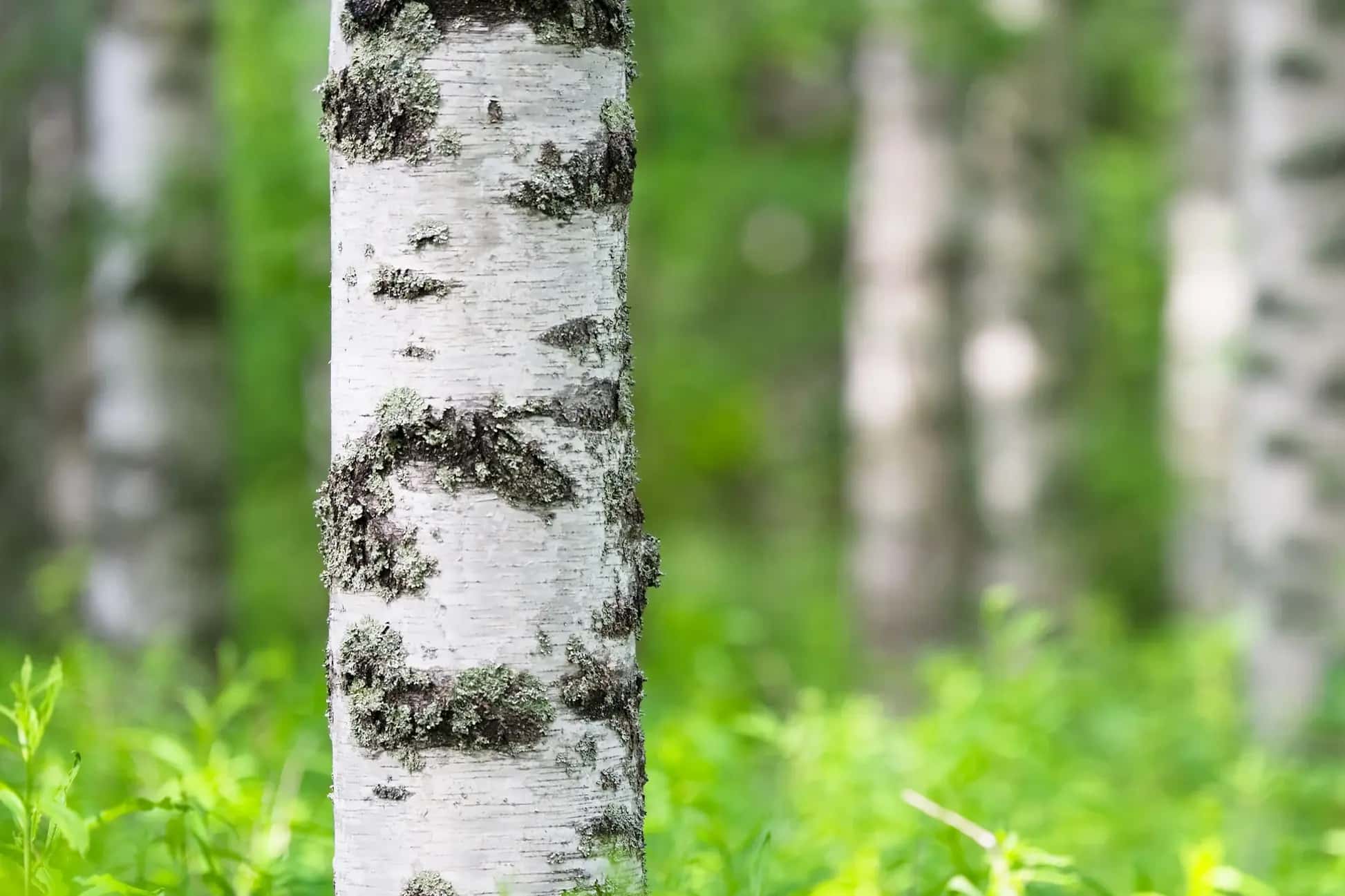
Another ancient tree of the Drenthe region is the birch, which is by no means as highly valued as the oak, largely because the quality of its wood is much lower. The birch is a fast-growing tree, and this always comes at the expense of the wood’s quality. The birch is virtually the only tree with predominantly white bark, making it so easy to recognise. The white patches first appear in later life. Young birch trees have ordinary brown bark. The birch is one of the first trees to turn brown in early autumn and to shed its leaves quickly. The birch does not, therefore, rely on its autumnal colour, yet there is an advantage to it becoming bare so quickly. Most other trees are not at their best when bare. With the birch, however, the white trunk is often more clearly visible than in summer; moreover, it is only when it is bare that one can see how finely branched the birch is – more so than almost any other tree. The small twigs, referred to here as ‘twigs’, are very flexible. They used to be used for all manner of purposes. A disadvantage of the many twigs is that other trees find it difficult to grow alongside a birch. In strong winds, the birch whips everything in its vicinity to pieces.
On somewhat damp ground, birch saplings spring up easily. Most of the birches at Westerbergen were therefore not planted, but emerged naturally from seeds carried by the wind. The area lying to the east of the vocational school section on the campsite is low-lying and wet and originally contained quite a lot of peat. In the fire of 1960, everything that stood here was destroyed and the peat was also burnt away. This created an ideal growing environment for birches, resulting in the formation of a tall, dense birch grove there. Elsewhere, the birches are scattered here and there across the site. In Drenthe, the birch is often used for planting along roadside verges. This is the case, for example, on sections of the Oshaarseweg towards Echten. It is more common further afield in Drenthe. It creates a striking effect, all those white trunks in a row.
The birch flowers in early spring with catkins, an inflorescence also found on the willow, amongst others. In the case of the willow, the catkins are initially grey, softly hairy buds, as soft as cat’s fur. This is how the name originated. The catkins are divided into male and female catkins. In the birch, the male catkins initially resemble green, thickened, scaly twigs a few centimetres long. Later, they become limp and hang downwards. They then turn brown with yellow speckles. If you blow on such a catkin, a cloud of yellow pollen emerges. The female catkins are less conspicuous. Fertilisation takes place within them, and the seed develops later.
Another fast-growing species is the alder. Before the fire of 1960, alders did not occur at Westerbergen. Everything was therefore planted afterwards precisely because of its rapid growth. Just how fast alders can grow can be seen at the entrance to the campsite. In the mixed woodland planted there, the alder trees are the tallest and now stand at ten metres or more in height. The alder has a smooth trunk. The dark green leaves are quite large. There are two types of alder: the grey alder and the white alder, both of which are found at Westerbergen. The leaves of the white alder are broad, almost circular, but they still end in a blunt point. The underside is white-bluish in colour, hence the name. The leaves of the grey alder are almost round. At the tip of the leaf, the edge often even curves back slightly. The underside of these leaves is light green. Another remarkable feature of the alder is that its leaves do not turn brown in autumn. They fall off whilst still green. The alder
also flowers with catkins. The male catkins resemble those of the birch. The female catkins are round. They are green at first, but later turn dark brown. They then become the familiar alder cones.
The currant tree is a rewarding tree. Although not native to Drenthe, this species was first imported into the region from Canada, meaning that for a time it was found almost exclusively in Drenthe. The currant tree grove in Dwingeloo was, and still is, well known. It is now found throughout the Netherlands. The currant tree is often more of a shrub than a tree and does not grow very tall. The tree is appreciated for its blossom and its autumn colours. It flowers in late April or early May, before the leaves have emerged. The flowers are white and measure a few centimetres in size. Usually, there are a great many flowers, clustered closely together and spread across the entire tree. Precisely because of the absence of leaves, the tree appears, as it were, as a single white mass. Unfortunately, the flowering period is short-lived. After a few days, the flowers begin to wither and fall off. At this point, the leaves emerge, initially a light brown colour, gradually turning green. The leaves are somewhat egg-shaped with very fine serrations along the edge. The autumn colours begin early, often as early as late August. Many colour variations then emerge, ranging from deep red to various shades of brown. As all the other trees are still green at this time, striking colour contrasts are created. In late autumn, the fruits are ripe; here, these are berries. They turn black-blue and tend to shrivel slightly. This makes the berries resemble currants. Hence the name ‘currant tree’. The currant tree is not related to real currants, which are small dried grapes.
The currant tree was not present at Westerbergen prior to the fire of 1960. They have been planted in the bungalow area amongst other tree species, and particularly along the ring road. Although they are still young and not yet very large, they nevertheless bloom profusely every year.
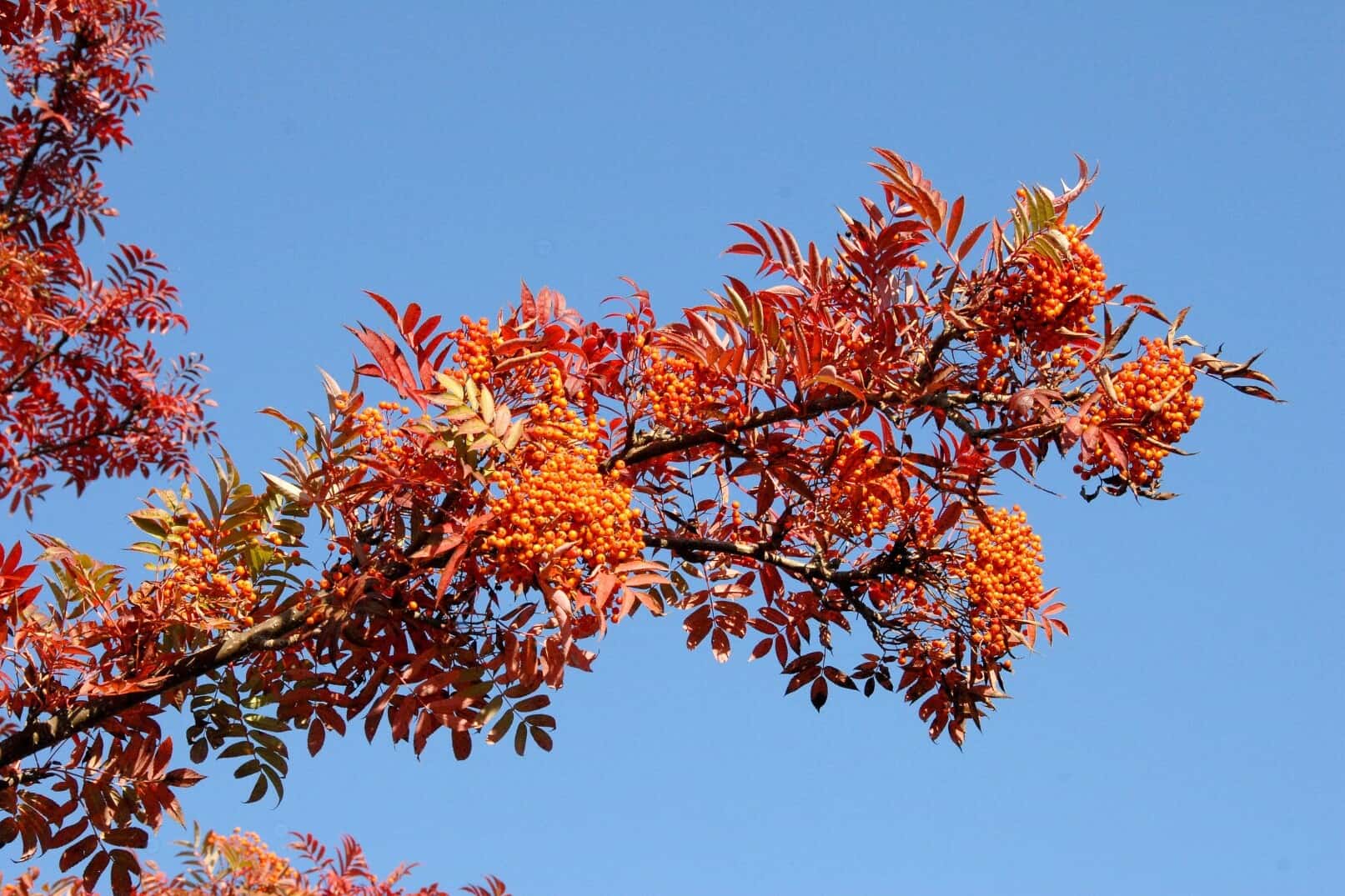
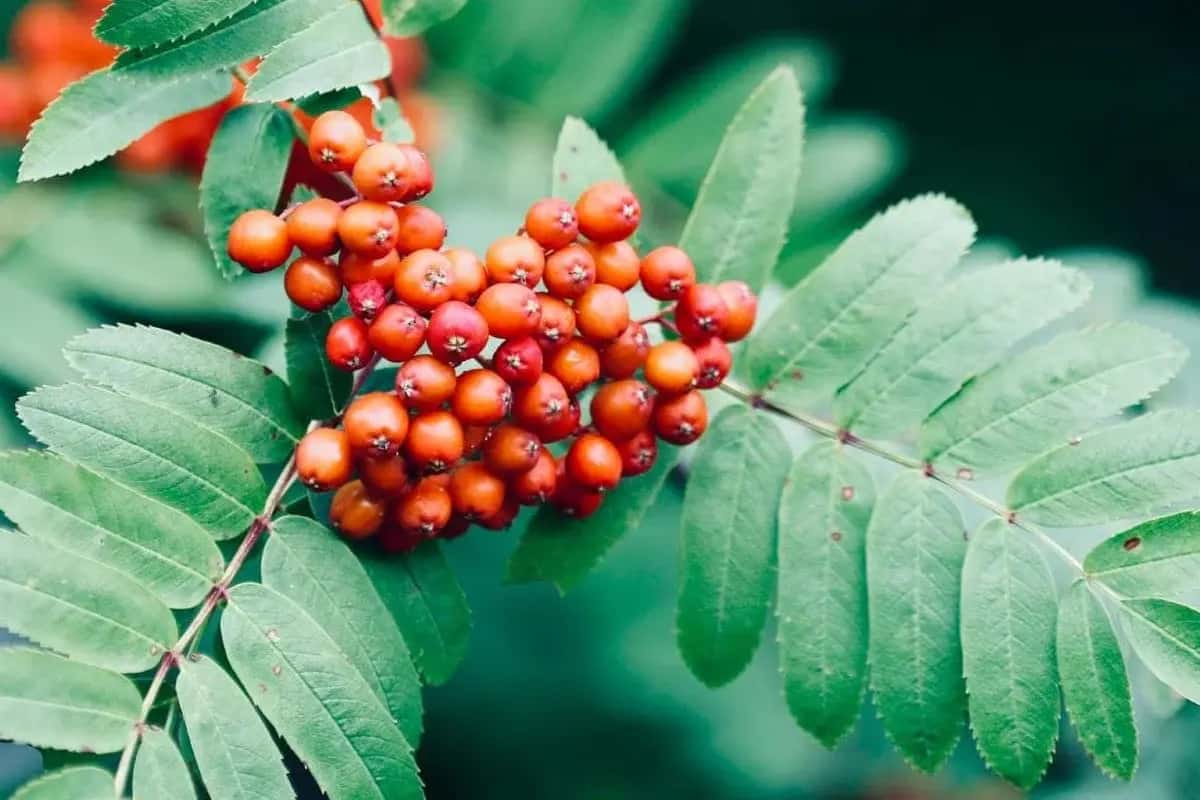
Another rewarding tree is the rowan, thanks to its flowers, its delicate leaves and its bright red berries. The flowering season is May–June. Large clusters of numerous yellow-white flowers then attract a great deal of attention. Even after it has finished flowering, however, the rowan stands out for its delicately shaped leaves. These are, as they say, pinnate, which means that each leaf actually consists of two rows of small leaflets, positioned directly opposite one another, and a single leaflet at the tip. Just like the leaves of the currant bush, these leaflets have fine serrations along the edge. Once the flowers have finished blooming, the fruits develop in the form of berries. Because the flowers grow in clusters, these berries also form a cluster, creating discs with a diameter of ten centimetres consisting entirely of berries. The berries are green at first, then orange and finally bright red, making them visible from a great distance. The berries are a special treat for thrushes and other birds, hence the name rowan. The berries contain a few pips, seeds that the birds drop far and wide or that leave the body via their droppings. The same method is therefore used here as with heather and the bird cherry, which is yet to be described.
The rowan is a tree, but can also branch out somewhat, resembling a shrub. It requires plenty of light and cannot therefore grow beneath closely spaced trees. It is found everywhere on Westerbergen. In recent years, a large number have grown spontaneously near the small pond. The woodland in this area was originally far too dense, so in 1963 a great deal was cleared to give the remaining trees a bit more space. This also made the ground lighter, and apparently created an ideal growing site for rowan trees.
Another distinctive feature of the rowan is that, in early spring, the bark can be quite easily stripped from the wood on the young branches. Country children make use of this to craft whistles from rowan twigs. Willow twigs have the same property, so they can also be used for this purpose.
The last of the trees to be discussed is the bird cherry. Just as with the last plant described, there are many who do not care for this tree and others who do. The bird cherry can grow into a tree of moderate height, but it usually branches out widely in all directions and is therefore more of a shrub. There are various species, but in the following we shall focus specifically on the American bird cherry. This is fairly easy to recognise by its leaves, which are quite pointed but have a strikingly glossy upper surface. The underside is lighter in colour than the upper surface and does not shine. The leaves are densely clustered.
The bird cherry flowers in May–June with pretty white clusters of flowers. Once these have finished flowering, the fruits develop, initially green in colour and later turning dark red to black. They resemble small cherries, which are eaten by many birds. It is clear that this is how the name ‘bird cherry’ originated. The resemblance to cherries goes even further, as each cherry contains just a single stone. The cherries are edible and have a refreshing, distinctive flavour. Not everyone can tolerate them, so consuming too many is not advisable. The bird cherry retains its leaves longer than most other trees and shrubs. It is not uncommon to see green specimens as late as December. Other specimens turn brown earlier and can then display beautiful autumnal hues. The above seems harmless, so it is not yet clear why the bird cherry is sometimes so despised. The reason is as follows: in tall forests, foresters often look for suitable undergrowth consisting of shrubs that do not grow too tall. This prevents the soil from drying out and, moreover, the fallen leaves of these shrubs can serve as food for the trees once they have decomposed.
At the time, it was thought that the ideal undergrowth had been found in the American bird cherry. However, the remedy has proved worse than the disease. When growing conditions are favourable, the bird cherry grows so rapidly and spreads so widely that it crowds out everything else and even hinders the growth of taller trees. Attempting to remove the bird cherry is virtually impossible. Cutting it down or spraying it with chemicals does not help, as the root stumps quickly sprout again. The wild cherry is, as it were, a weed in the forest. Consequently, in forestry circles it is often referred to as a forest pest. If you follow the red walking route, you will come to a clearing with a picnic area fairly soon after Echtener Zand. This is described in the chapter on the walking routes. Just before the picnic area, you can see whole fields of bird cherry on the left beneath the trees. Here, it has indeed become a pest.
However, there are those who do appreciate the bird cherry. These are the managers of holiday resorts. Firstly, because it is a beautiful shrub with its white flowers and striking leaves, and because it retains its leaves for so long. The bird cherry is particularly suitable as a windbreak on campsites and similar sites. It grows quickly and, thanks to its closely spaced leaves, provides good shelter from the wind. It does not grow too tall, so the site is not constantly in the shade. Moreover, at a holiday resort there are usually people available who can prune it back if the bird cherry growth threatens to get out of hand.
At Westerbergen, the growing conditions are apparently not as favourable as in the aforementioned area in the state forests. There is no single area where too much bird cherry has grown. It is scattered throughout the entire site. There are several specimens along the ring road through the bungalow area, further on in the camping area, and a fairly large number at the edge of the wood near the first burial mound.
This text is taken from the booklet ‘The Origins of Westerbergen’, compiled by Dr E.J. Offerhaus
Sign up for the newsletter
Protected by reCaptcha, Privacy Policy and Terms of Service apply.